This series of articles focuses on the fundamental sources necessary for reconstruction. The aim is to create an objective research base, allowing one to start researching costume in the 13th century. These articles centralise the archaeological sources available on a particular subject, so that they can be reproduced or further researched.
The tunic (also known as a cotte) is the most important element of the costume. From the few archaeological finds we have, we can see that the tunics were made with a certain care, even for the peasants/craftsmen(1) (rounding of armholes, finishing of seams, etc.). At present, the number of archaeological and textual sources concerning the cotte are quite small, which does not allow us to have much certainty. The most important points for a successful cotte/tunic reconstruction are to have a good pattern, as well as a coherent length, width and lining(2).
(1) The archaeological pieces from Greenland, which are not rich coats, have rounded armholes that show a certain amount of craftsmanship. E. OSTERGARD, Woven into the Earth, Aarhus, Aarhus University Press, 2004, 296 p.
(2) The issue of dyes will be discussed in a later article.
Patterns
There are few archaeological finds of Western tunics from the 13th century. The preservation of textile pieces is very difficult and the remaining pieces are often religious. It is therefore necessary to open up to archaeological finds from the 12th and 14th centuries, and then compare them with iconographies from the 13th century, to obtain coherent tunics. Most of the coats found come from the Nordic countries (Greenland, Sweden, Denmark), as these are peaty/marshy soils that best preserve woolens.
Two archaeological pieces will not be included: the saya of Fernando de la Cerda. It is from the 13th century and very well preserved, but the saya is a Spanish fashion garment with its own patron saint. The second tunic is that of Saint Francis of Assisi, preserved in Cortona. Although some historians theorise that it was used on a daily basis, the wearer and the pattern (without front and back triangles)(3) have a significant religious context which distances it from civil fashion.
(3) The pattern is identical to that of the alb preserved from the medieval period.
The two Danish tunics from the 12th century:
The Kragelund tunic (carbon-dated 1045-1155) is the last archaeological tunic with straight armholes (which therefore does not appear on later medieval tunics). It has an amigaut (slit in the collar) in front and behind. It is made of a 2/1 wool twill (brown and white). The sleeves are: left length: incomplete; right length: 63cm; left wrist circumference: incomplete; right wrist circumference: 23.5cm.
The Moselund tunic (carbon-dated 1050-1155) is a fairly elaborate tunic. The armholes are anamorphic to allow easy movement. It is made of 2/1 fuller wool twill (brown). It has a front amigaut. The sleeves are identical: sleeve length: 53cm and cuff circumference: 22.3cm.
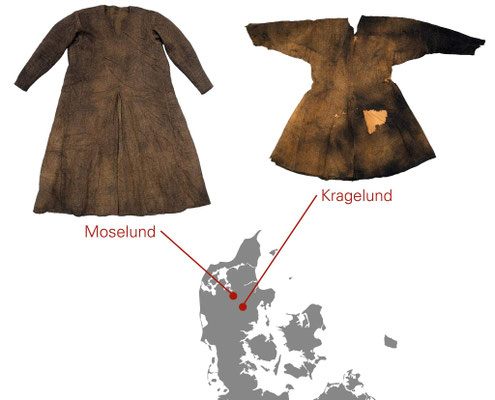
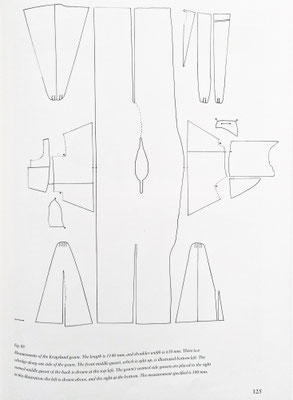
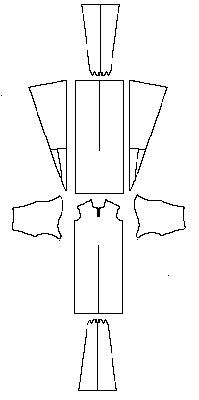
The Ronbjerg Tunic (Greenland):
The so-called Ronbjerg Garment is classified as D2625a-e in the Herjolfsnaes cemetery finds. It is compared on many technical points with the Moselund tunic. It has been carbon-dated to between 1180-1310, found with pottery dated 1200-1243. It is made of 2/2 wool twill (dark brown). Its advanced state of decomposition makes it less prestigious than other Greenlandic tunics, but it remains the oldest tunic found in the country. The missing sleeves, as well as many pieces, force one to give approximations as to the total size of the piece. Although it is the smallest tunic, these side cups are the largest of the pieces presented here (47.5 cm).
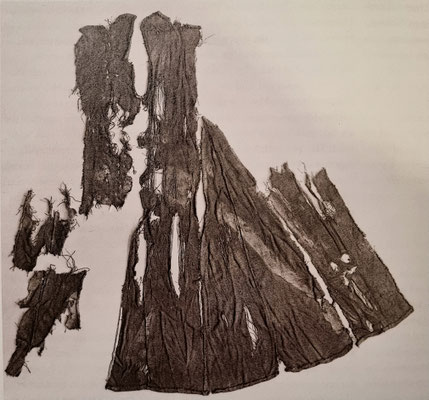
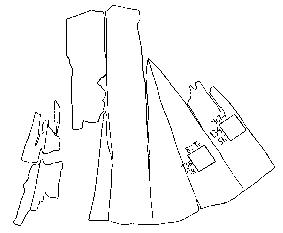
The Soderkoping tunic:
Little is known about this shirt. It was found in Sweden at Soderkoping. It could be dated by carbon 14 between 1200-1242. It is made up of the same principle as all the other tunics here: 4 side buckets (2 on each side); 2 front buckets and 2 back buckets (type 1c of Herjolfsnaes' classification). It is a 2/1 wool twill (blue and red). There are really too few elements left to extrapolate even approximate dimensions.
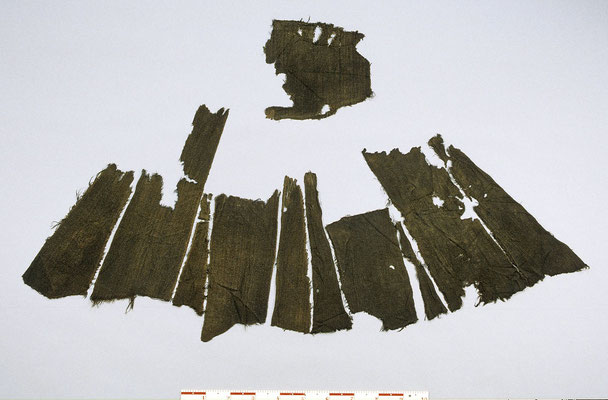
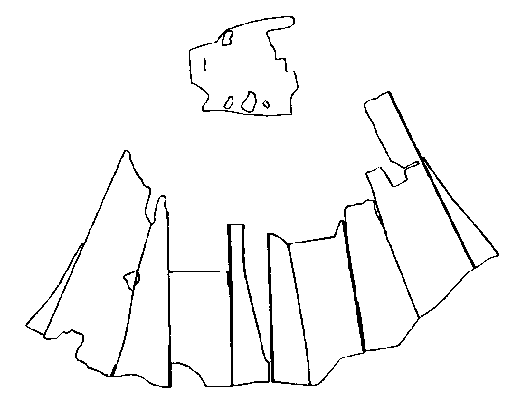
The 14th century tunic from Sweden:
The so-called Boksten tunic is the latest in this corpus. It was found together with other pieces of clothing on the corpse of a young man. Scientists have been able to determine from the weave lines that the piece of cloth from which the garment was made is a 4.5m by 55cm piece. The wool is a 2:1 (brown) fulling wool twill. The stitching threads have not been preserved (they are presumed to be linen). Like the other coats except the Kragelund, the armholes are rounded. The circumference of the collar is 82 cm. The sleeves are different: left length: 59.5cm; right length: 61cm; left wrist circumference: 22cm; right wrist circumference: 23cm.
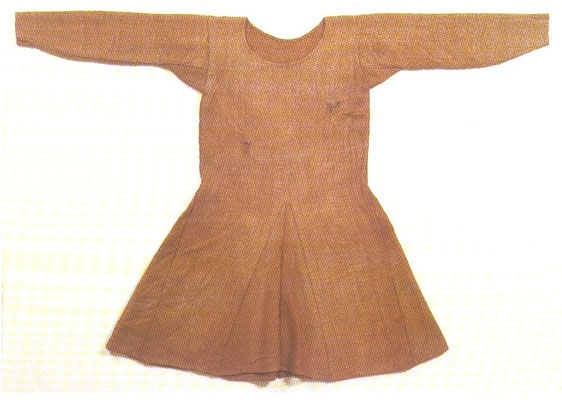
The length
Although the length of the cottes is a subject that seems to be unanimously accepted: below the knee for peasants and craftsmen; mid-calf or more for the bourgeois and merchants; at the ankle for the nobles... The subject is more complex. The reality is more nuanced (shorter hunting outfits for the nobles, for example). It is therefore necessary to refer to the archaeological pieces and then compare them with the iconography and the texts to be able to have a length coherent with the situation and the character. By length, I mean the linear length from the shoulder to the bottom of the tunic. Specifying their length as well as the height of the wearer is necessary to understand how far down they went on the wearer's body.
| Name of the piece | Tunique de Moselund | Tunique de Kragelund | Tunique de Ronbjerg | Tunique de Soderkoping | Tunique de Bocksten |
| Lengh (cm) | 128 | 114 (pas d'info squelette) | 113.5 | indéterminée | 115 |
| Size of the wearer (cm) | 180 (mi-mollet) | 190 (haut du mollet) | indéterminée | indéterminée | 172.5 (haut du mollet) |
The scale
The size of the site is a subject that has been and is still being debated. The widths given here are those of the archaeological finds reported above. The fullness is defined as the total circumference of the bottom of the garment (it is enough to add up each width at the bottom of the different pieces). This is important because, depending on its size, it allows the creation of many natural folds.
| Name of the piece | Tunique de Moselund | Tunique de Kragelund | Tunique de Ronbjerg | Tunique de Soderkoping | Tunique de Bocksten |
| Scale (cm) | 248 | 241,5 | 220 (minimum approx.) | indéterminée | 250 |
The lining
The lining has almost become an automatism for the reconstructors. However, archaeological finds are much more nuanced. The presence of a lining is not always attested. The absence of lining can be justified by a linen lining having disappeared at the same time as the sewing threads (especially on pieces from the Nordic countries). On more "exotic" pieces, linings are attested (the texts confirm it): the saya of Fernando de la Cerda has a taffeta silk and rabbit fur lining; one of the tunics attributed to Saint Francis of Assisi has a linen lining (plain weave).
| Name of the piece | Tunique de Moselund | Tunique de Kragelund | Tunique de Ronbjerg | Tunique de Soderkoping | Tunique de Bocksten |
| Presence of lining | non | non | non | non | non |
Conclusion
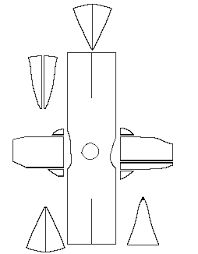
All these archaeological finds show us a certain uniformity in the way a male civilian garment was composed throughout the 13th century West. It can be classified as type 1c in Herjolfsnaes' classification.) This means two pieces (front-back); 4 side cups (divided 2 on each side); 2 front cups; 2 back cups; rounded armholes and a rather rounded or oval collar (sometimes with an opening). It should be noted, however, that the pieces presented here are not noble or rich bourgeois garments. The reproduction of these pieces with the identical ones are favourable for peasants or craftsmen. This does not prevent the use of these patterns, while adapting them, to produce more luxurious tunics (For this: cross-check with other sources to justify the approach).
Bibliographical references
- E. COATSWORTH & R. OWEN-CROOKER, Clothing the Past Surviving Garments from Early Medieval to Early Modern Western Europe, Boston, Brill, 2018, 453 p.
- E. CROWFOOT, F. PRITCHARD, K. STANILAND, Textiles and clothing 1150-1450, Woodbridge, Boydell Press, 1992, 223 p.
- K. KANIA, Kleidung im Mittelalter, Viennes, Böhlau, 2010, 529 p.
- E. OSTERGARD, Woven into the Earth, Aarhus, Aarhus University Press, 2004, 296 p.